
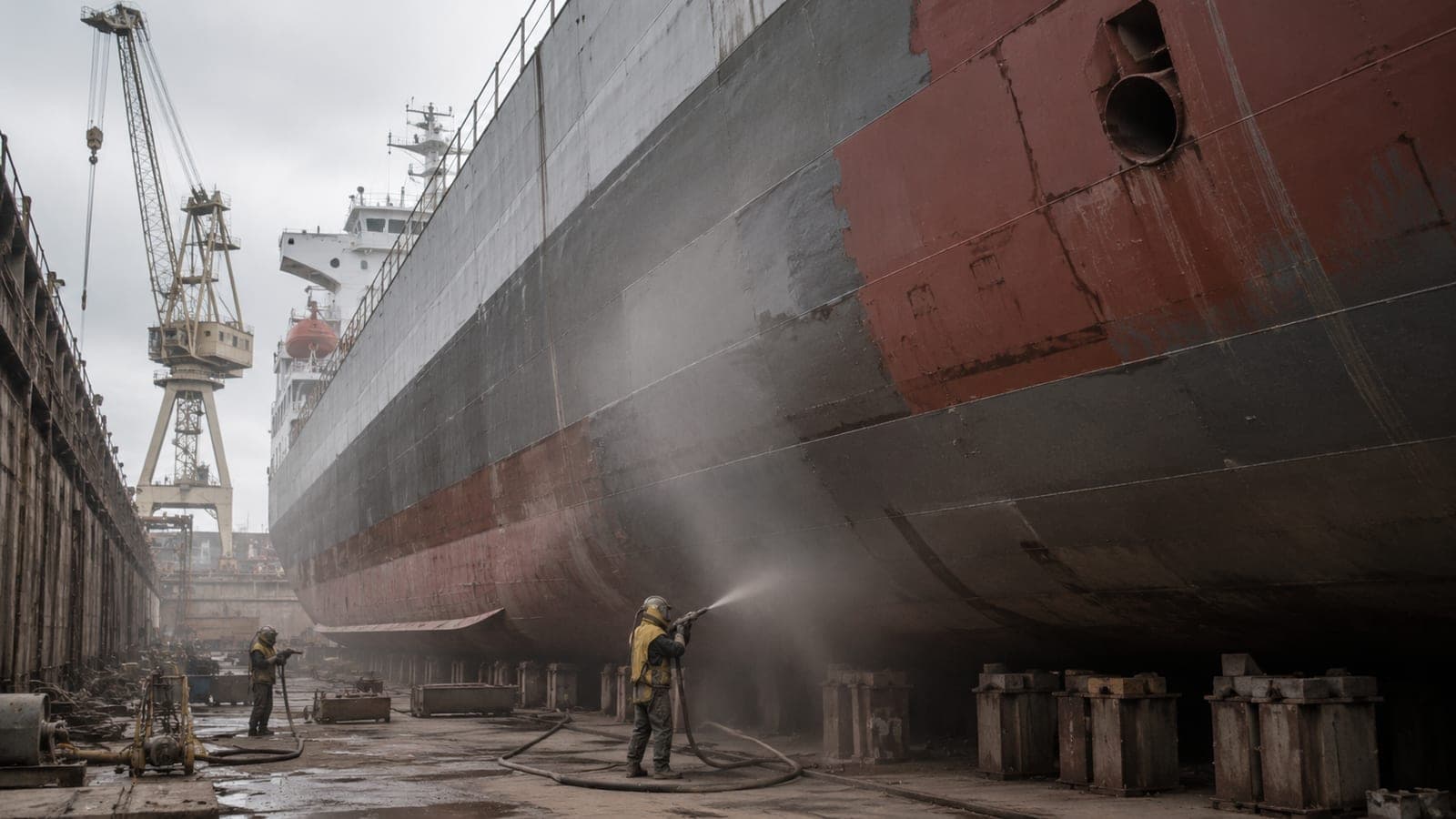
Sandblasting for Shipbuilding and Ship Repair
Salt water and constant humidity destroy metal many times faster than on land. Hull preparation is a critical stage before applying any protective coating. We perform sandblasting in docks and on slipways, meeting classification society requirements.
- Hull cleaning of underwater and above-water sections to Sa 2.5–3 per ISO 8501
- Marine fouling removal, old anti-corrosion systems and coatings
- Work in docks, on slipways, in dry docks — mobile equipment on site
- Preparation for leading anti-corrosion systems: Jotun, Hempel, International
- Documentation for classification societies (Lloyd's Register, Bureau Veritas, DNV)
Full cycle of surface treatment and protection
Corrosion of a vessel's underwater hull is the most costly type of corrosion in industry. Sea water, the tidal splash zone, microbial fouling and cavitation attack a steel hull at a rate of 0.1–0.3 mm per year. Without protection, within 10 years a vessel loses up to 30% of its structural hull strength and fails classification survey.
Vessel sandblasting by TEHMAS meets the requirements of IACS, Lloyd's Register and DNV GL. We clean hulls to Sa 2.5 or Sa 3, then apply anti-corrosion and anti-fouling systems from Jotun (Sea Force, Hardtop) and Hempel. Experience in the docks of Odesa, Mykolaiv and Kherson — over 200 vessels of various classes.
Our naval architect prepares a bespoke process map for each vessel: the hull, waterline zone, superstructure and internal hold surfaces have different corrosion conditions and require different coating systems. You receive not just a coating — you receive protection until the next scheduled docking in 5 years.
Vessel Treatment Process in Dock
Hull Survey and Process Map
After the vessel enters dry or floating dock: ultrasonic hull thickness gauging, identification of corrosion and pitting zones, measurement of residual steel thickness. Process map compilation: zones Im1 (submerged), Im2 (splash), C5-M (above-water).
Fouling Removal and Preparation
Hydraulic or mechanical removal of mussels, algae and old anti-fouling coating. Then — sandblasting to Sa 2.5 (underwater section) or Sa 3 (waterline zone). Abrasive: copper slag or steel shot depending on zone.
Inspection and Defect Repair
After cleaning: ultrasonic inspection of identified pitting zones, welding and filling of deep pits. Survey by classification society representative. Signing of inspection report.
Anti-Corrosion System Application
Underwater section Im1: epoxy primer + intermediate coat + anti-fouling coating (TBT-free) total NDFT 300–400 µm. Waterline zone Im2: reinforced system 350–450 µm. Superstructure C5-M: zinc-rich primer + polyurethane topcoat. Application by airless spray.
Final Inspection and Documentation
DFT measurement of every layer with Elcometer 456 — across the full hull area. Pull-off adhesion test. Documentation for classification society: reports, material data sheets, DFT map. Coating warranty for underwater section — 60 months until next docking.
Vessel Types and Marine Facilities
Cargo and Tanker Vessels
Bulk carriers, tankers, container ships. Hull, hold and cargo tank protection. Systems certified for contact with petroleum products and food cargoes.
Passenger and River Fleet
Ferries, river passenger vessels, yachts. More delicate systems for superstructures and decks, anti-fouling protection, decorative hull coatings.
Port and Coastal Infrastructure
Quay structures, steel piles, crane rail girders. Splash zone and atmospheric zone — combined Im2 + C5-M systems.
Offshore and Technical Facilities
Platforms, pontoons, dredgers, work vessels. The most aggressive conditions — Im3/CX category systems with 10+ year service life.
Technical Specifications for Vessel Treatment
- Cleaning standard
- Sa 2.5 / Sa 3 (ISO 8501-1, SSPC-SP 10)
- Underwater section protection system
- ISO 12944 Im1, NDFT 300–400 µm
- Waterline zone
- Im2, NDFT 350–450 µm
- Materials
- Jotun Sea Force, Hempel Olympic, TBT-free
- Coating adhesion
- ≥ 6 MPa underwater zone (pull-off)
- DFT control
- 100% of surface, Elcometer 456
- Underwater section warranty
- 60 months (5 years until next docking)
- Documentation
- For Lloyd's Register, DNV GL, Ship Register
Questions from Vessel Owners and Operators
How long does hull treatment in dock take?
For a vessel 80–120 m in length: hull cleaning — 3–5 days, coating system application — 3–4 days, curing and inspection — 1–2 days. Total 7–11 working days for a standard cargo vessel. Exact timeline — after survey, depending on hull condition.
Does your system meet classification society requirements?
Yes. Jotun and Hempel materials hold Type Approval from Lloyd's Register, DNV GL, Bureau Veritas and the Ship Register of Ukraine. We provide full documentation for classification survey: reports, material data sheets, DFT map.
Will the protection last 5 years until the next docking?
Standard systems Jotun Sea Force 60 and Hempel Olympic are designed for a 60-month service life with correct application. The key condition is Sa 2.5 at time of application. We provide a written 5-year warranty and accept responsibility for the result.
What is TBT-free coating and is it mandatory?
Tributyltin (TBT) has been banned by IMO since 2008 (AFS Convention). All anti-fouling coatings we apply are TBT-free — copper-acrylic or hydrolysis-based without organotin biocides. This is a mandatory requirement for any vessel entering international waters.
Can treatment be carried out without dry-docking?
The underwater section — only in a dry or floating dock. The superstructure, deck and waterline zone can be treated afloat in port with port authority permission. For full hull protection — docking is mandatory.