
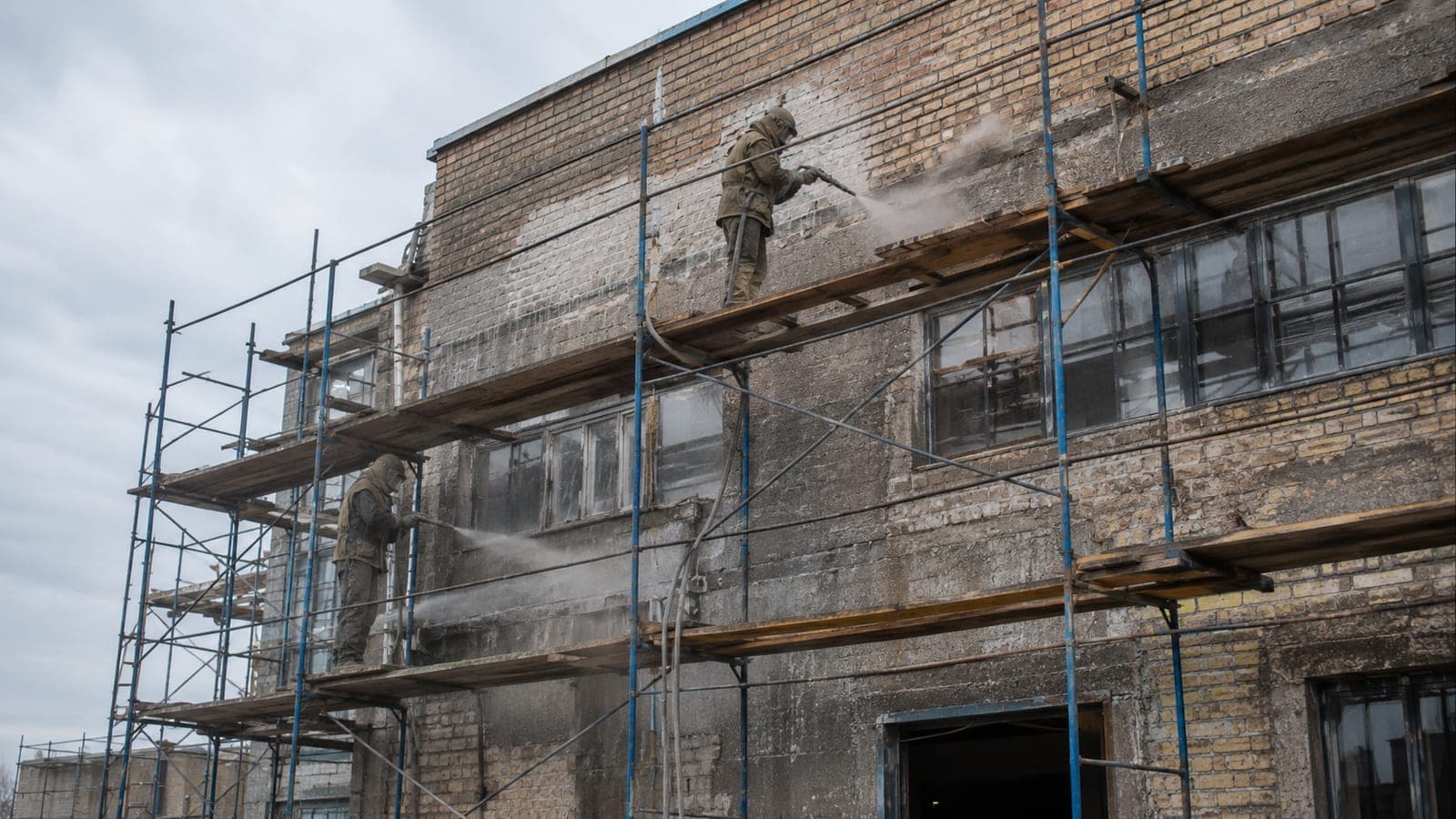
Sandblast Cleaning of Building Facades
Industrial buildings, warehouses, office complexes — dirty facades reduce property value and company reputation. We restore appearance with delicate low-pressure sandblasting — without damaging the material and without stopping enterprise operations.
- Soft blasting — low pressure for brick, granite, decorative plaster
- Graffiti, efflorescence, atmospheric blackening removal without surface damage
- Natural stone and face brick restoration while preserving texture
- Work during facility operation — no downtime for the enterprise
- Suitable for architectural landmarks and buildings under renovation
Full cycle of surface treatment and protection
A facade of an industrial building or warehouse with dark streaks, biological growth and paint residues is not just an aesthetic issue. It is a signal to tenants and partners about the standard of facility management. For brick and concrete surfaces it is also a technical problem: mosses and lichens destroy the surface, and accumulated moisture accelerates concrete carbonation.
Facade sandblast cleaning by TEHMAS removes: old paintwork, soot, biological growth, salts (efflorescence), rust streaks and atmospheric contamination. We select abrasive type and pressure for the substrate: softer for face brick and natural stone, standard for concrete panels and metal profiled sheeting.
Work is carried out from rope access, lifts and scaffolding — the method depends on height, building geometry and site constraints. After cleaning we apply protective impregnation or paint — preserving the result for years.
Facade Sandblast Cleaning Process
Facade Survey and Process Selection
Identification of facade material (brick, concrete, render, metal profiling), contamination type, surface condition. Test treatment on a concealed area: pressure and abrasive grit are calibrated to avoid damaging the face layer.
Protection of Adjacent Surfaces
Covering windows, doors and ventilation openings with protective film. Protection of pavements and the surrounding area from abrasive fall-out and contamination. Placement of warning signs and work zone barriers.
Sectional Sandblast Cleaning
Treatment from bottom to top in sections — so that falling abrasive does not re-contaminate already-cleaned areas. Pressure 3–7 bar depending on material. For brick and stone — fine abrasive 0.3–0.8 mm, pressure 3–4 bar. For concrete panels — 0.5–1.5 mm, pressure 5–7 bar.
Neutralisation and Rinsing
After mechanical cleaning — pressure washing of the facade to remove abrasive residues and dust. Where efflorescence is present — additional treatment with neutralising solution. Drying 24–48 hours before coating application.
Protective Impregnation or Painting
Application of hydrophobic impregnation (Siloxane or Silane-Siloxane) to protect against re-contamination and moisture. Where required — facade paint or decorative render. Facade cleanliness warranty — 5–7 years.
Applicable Facilities
Industrial Buildings and Production Facilities
Concrete and brick facades of factory buildings. Removal of soot, rust streaks from metal structures, old coatings before rebranding.
Logistics Centres and Warehouses
Large areas of metal profiled sheeting and sandwich panels. Cleaning of atmospheric grime and preparation for painting in corporate colours.
Office and Retail Buildings
Facades with face brick, decorative stone and render. Delicate cleaning preserving texture without surface damage.
Architectural Heritage and Special Facilities
Historic brick and natural stone. Low pressure, fine abrasive, approved process — in compliance with heritage authority requirements.
Technical Specifications for Facade Cleaning
- Working pressure
- 2–7 bar (depending on material)
- Abrasive for brick/stone
- Quartz sand 0.3–0.8 mm
- Abrasive for concrete/metal
- Copper slag 0.5–1.5 mm
- Access method
- Rope access, aerial platform, scaffolding
- Maximum height
- Up to 60 m (platform), unlimited (rope access)
- Protective impregnation
- Silane-Siloxane, service life 7–10 years
- Output
- 200–600 m²/shift (open plane)
- Result warranty
- 2 years on cleaning, 5 years on coating
Questions About Facade Cleaning
Will sandblasting damage old brick or render?
For soft materials we reduce pressure to 2–3 bar and use fine abrasive. Before starting we always carry out a test on a concealed area — we see the result and agree it with the client. If the surface is very fragile — we propose chemical cleaning as an alternative.
Can facade cleaning be done in rainy weather?
Dry sandblasting — no. The surface must be dry and temperature above +5°C. Wet sandblasting — possible at temperatures above 0°C. But protective coating application after cleaning requires dry weather. We plan the work schedule according to the forecast.
How long will a clean facade stay clean without re-contamination?
Without protection — 2–3 years before contamination returns. With Silane-Siloxane hydrophobic impregnation — 7–10 years. Water and dirt run off the treated surface without adhering. We always recommend completing cleaning with impregnation application.
What happens to the abrasive — does it stay on site?
Spent abrasive and contamination products are collected by industrial vacuum and manually. Removed to a licensed disposal facility. Your site remains clean. The cost of clean-up and disposal is included in the estimate.
Can the facade be cleaned while people are working inside the building?
Yes, provided conditions are met: windows and ventilation openings closed, work zone fenced, no persons directly below the work area. With rope access — one section at a time, minimal impact on the building.